

Digital Marketing - Study Notes:
What is keyword cannibalization?
Keyword cannibalization is something that something you shouldn’t worry about, but it is something that often beginners don’t quite get right.
And let’s have a look at Rand Fishkin’s definition. Now, Rand Fishkin is the founder of moz.com, one of the leading SEO websites, and he says that:
Keyword cannibalization starts when a website’s information architecture calls for the targeting of a single term or phrase on multiple pages of the site.
If you’re quite new to SEO, the more times you mention a phrase on a page, you know, surely Google will pick one of them. It’s increasing your chances. And I can see that logic, but it really doesn’t help things. And let’s just kind of have a look visually why that’s the case.
Consequences of keyword cannibalization
Here is an image which is Googlebot, so Google’s crawler, and it’s found four pages on a website and it’s really struggling to try and work out which page is actually about snowboards.
So, in this case, what’s probably happened is “snowboards” has been optimized in the title tag. It’s in the heading. It’s in the content. There’s internal links pointing to all those four pages with the anchor text “snowboards”, and it’s very confusing. It means the search engine is going to struggle to pick the right page. It could be considered keyword stuffing, which isn’t good, and it really limits the number of keywords that you can actually target. Because, in this example, there’s four pages and we could target different phrases on each of those pages. But if we’re trying to cram the same keyword into all those pages, then we’re going to struggle to achieve that.
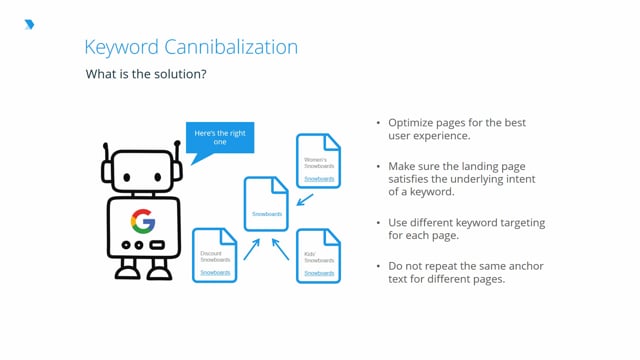
What’s the solution?
So, let’s have a look at what a better scenario.
In this example, Googlebot’s much happier because it’s very clear what the Snowboard’s page is. And, in fact, those three other pages were subtopics or subpages within Snowboards.
So, we’ve got “women’s snowboards”, we’ve got “kids’ snowboards”, and we’ve got “discount snowboards”. We’re increasing the number of phrases we’re targeting on those different pages. And it’s very clear, because we’re internally linking to the Snowboards page. The heading is about snowboards on that main page. And not only is this useful for Google, it’s obviously going to provide a better experience for the user as well.
Back to TopJoe Williams
Joe Williams has been an SEO specialist for over 20 years, consulting and training many large blue-chip companies including The Guardian, Cosmopolitan, and Sky. He holds a degree in Computing Informatics. He works across SEO and AI at Joe Wills, and shares Carve, his AI productivity method which helps him with SEO, at Carvable. He's on a mission to make SEO easy, fun, and profitable. You can catch him on X and LinkedIn.